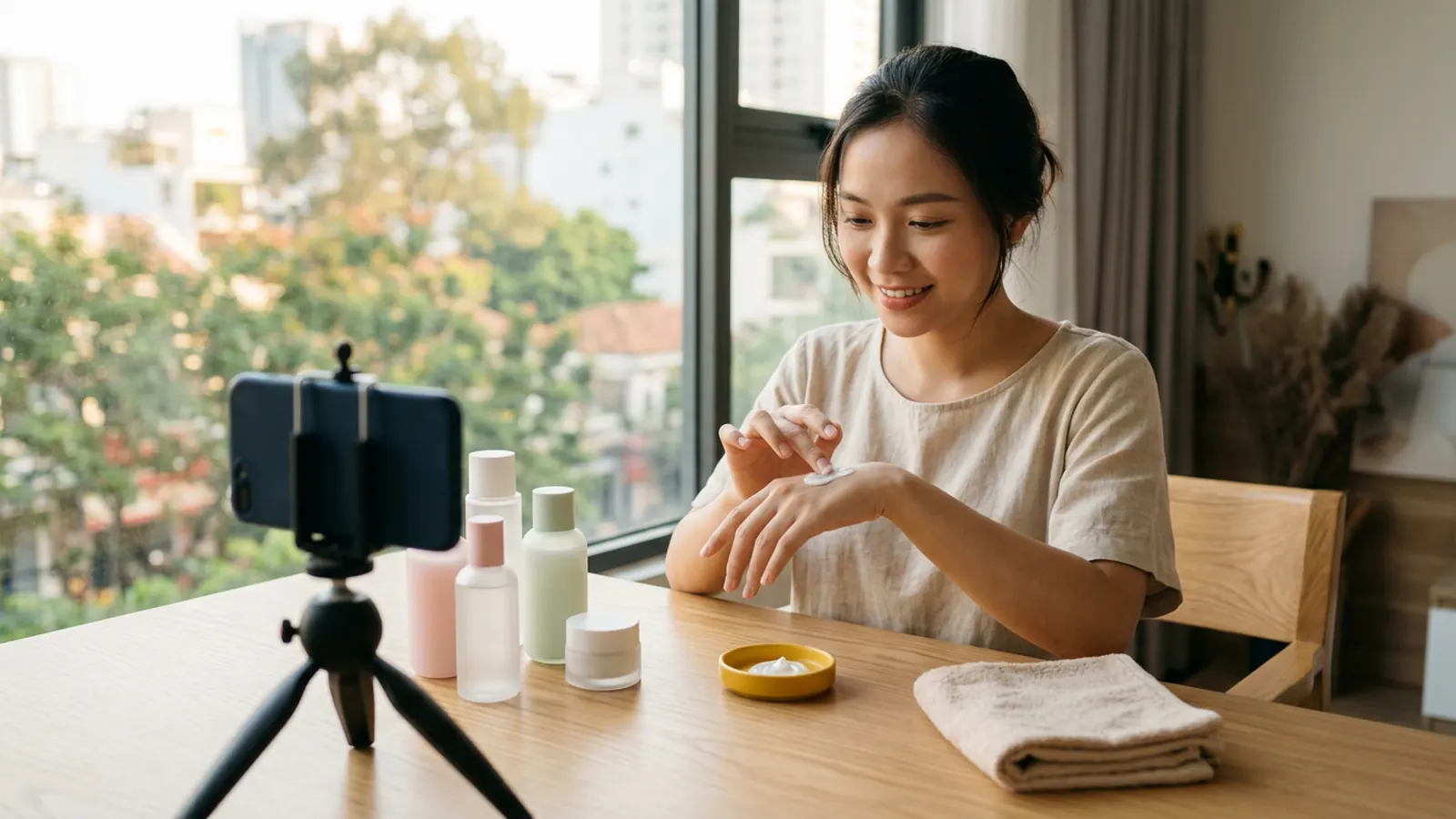
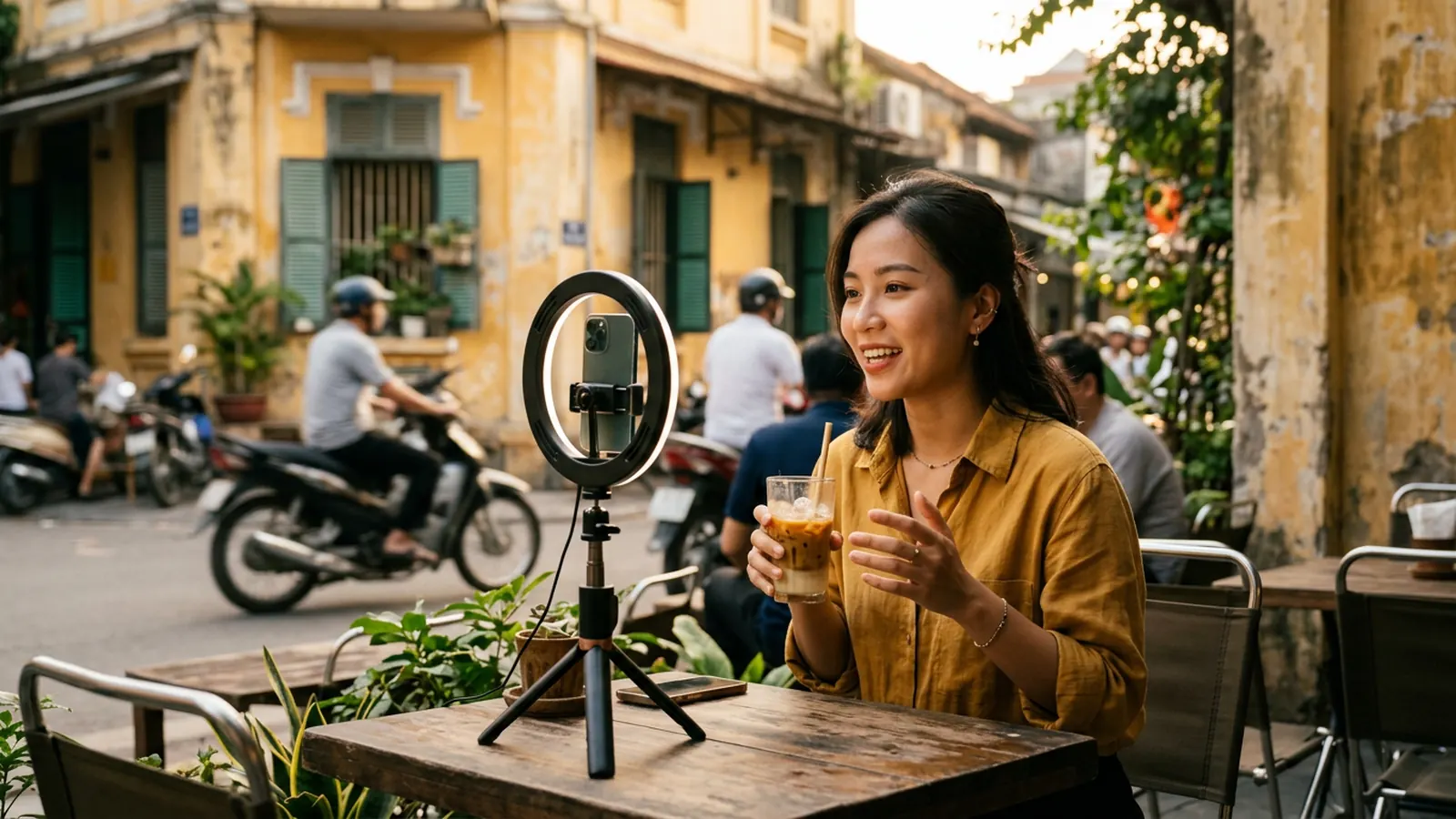
Korean brands in Vietnam
Korean Brands in Vietnam: A Creator Marketing Roadmap for Operators
For Korean brands, Vietnam marketing through creators works best when it starts with structure, not with a creator list. Confirm who sells and who holds the product documents, fill search results with KOC reviews, then scale with KOLs and livestreams. This roadmap covers the steps most market-entry articles skip: shop and notification ownership, localising Korean claims, paying creators and reporting results to head office.
Short answer
How should a Korean brand market in Vietnam with creators?
First decide who sells in Vietnam and who holds the product notification. Then seed KOCs so TikTok, Shopee and search results show real reviews, and only then add KOLs and livestreams. Throughout, run localised claims, advertising disclosure, compliant creator payments and an agreed reporting format for head office.
- Sales route: importer or distributor, own Vietnamese entity, or cross-border programme
- Cosmetics need a product notification held by a Vietnamese business
- Phase 1: KOC seeding for reviews and search presence
- Phase 2: KOLs and livestreams for reach and sales peaks
- Rewrite Korean claims in Vietnamese with supporting documents
- Agree the HQ reporting template before the campaign starts
1. Korean brands in Vietnam: why marketing starts with structure
Creators only perform on top of a working sales structure. If a viewer cannot buy on TikTok Shop or Shopee after watching a review, or if content has to come down because a required product document is missing, the booking budget is simply lost.
So the first question for Korean brands in Vietnam is not which KOL to book. It is who sells, who holds the documents and who pays the creators. Once those three answers are settled, creator strategy becomes much simpler. When they are not, responsibility bounces between head office in Seoul, the Vietnamese distributor and the agency.
2. Who sells: distributor shop, own entity or cross-border
Korean brands usually sell in Vietnam through one of three routes: an importer or distributor that runs the shop and stock, their own Vietnamese entity, or a platform's cross-border programme.
For TikTok Shop, the information conflicts. TikTok Korea's newsroom announced a 'Korea-SEA cross-border' solution on 13 November 2025, listing Vietnam among five Southeast Asian markets a Korean company can enter with a Korean business registration, a Korean passport, a domestic address and a virtual account. TikTok Shop's seller registration help article, however, says sellers must reside in the country they choose for their shop. Conditions may differ by category and over time, so confirm eligibility directly in Seller Center and with your TikTok contact.
Whatever the route, marketing needs the same answers: who controls price and vouchers, the affiliate commission plan, sample stock and edits to the product page. If a distributor runs the shop, put that split in the distribution agreement.
TikTok Shop Vietnam entry for Korean brandsTikTok Shop Vietnam guideBrand vs distributor responsibilitiesKorean brands on Shopee VietnamKorean brands contacting Vietnamese influencersReporting to Korean HQSeven mistakes Korean brands make
3. The cosmetics notification comes before any campaign
For K-beauty, the product notification is a precondition for marketing. Article 20 of the Law on Advertising as amended by Law No. 75/2025/QH15 requires cosmetics advertising to have a cosmetic product notification. Under Circular 06/2011/TT-BYT, the organisation responsible for placing the product on the market is the one named on the notification, must be licensed to trade cosmetics in Vietnam, and needs a letter of authorisation from the manufacturer or owner for imported products, with signature certification and consular legalisation unless an exemption applies.
Without a Vietnamese entity, the importer or distributor usually holds the notification. Agree the term and scope of the authorisation, and what happens to the notifications if you change distributor. A list of notification numbers per SKU is the first checkpoint before any creator receives a sample.
4. Phase 1: KOC seeding to fill search results
Vietnamese shoppers search product names on TikTok, Shopee and Google to find real-user reviews. If those results are empty at launch, even people who saw a KOL video struggle to buy. So the first phase is seeding: sending product to many KOCs to build reviews. Korean agencies that support brands in Vietnam, such as SIXONE, recommend the same order.
Mix free product (freecast), small paid fees and TikTok Shop affiliate commission. Spread creators across skin types, regions and age groups, and ask for usage reviews and routines rather than unboxing only. Article 15a of the amended Law on Advertising says influencers may not introduce products they have not used or do not understand, so time to use the product is a legal requirement as well as a quality one.
Example: a Korean sun-care brand seeds 50 KOCs four weeks before launch, asks them to post after two weeks of use and to tag the TikTok Shop product, so the product page and search results show reviews on launch day.
K-beauty KOC seeding in VietnamKOC freecast modelProduct seeding campaign guide
5. Phase 2: scale with KOLs and livestreams
Once reviews exist, KOLs widen reach and livestreams create sales peaks. KOLs add credibility and talk value; livestreams convert with time-limited offers and live Q&A. Timing them for mega-sale double days or a launch event multiplies the effect.
Since 1 July 2026, under the Law on E-commerce No. 122/2025/QH15 and Decree 248/2026/ND-CP, individuals selling by livestream, including KOLs and KOCs, must complete identity verification before broadcasting sales sessions, according to the Ministry of Industry and Trade. Add verification status to your host booking checklist and check that prices, stock and benefit statements in the run-of-show are accurate.
6. Localising Korean claims: rewrite, do not translate
Translating Korean product-page claims word for word is a common source of trouble. Article 19 of the amended Law on Advertising requires advertising content to be truthful, accurate and clear and not to mislead about features or effects, and Article 8 prohibits comparing your product with others' without lawful supporting documents. Phrases such as 'number one in Korea' are safest left out unless you have the source, period and proof.
In practice, build a separate approved claim list in Vietnamese. For each claim, record the supporting document, the channels where it may be used and the phrases to avoid, and use the same list for briefs and draft review. Also remove anything that makes a cosmetic sound like a medical treatment.
- Claim in Vietnamese with the Korean original
- Supporting document, source and reference period
- Channels where the claim may be used
- Forbidden phrases and safe alternatives
- Approver and approval date
7. Briefs and approvals between Seoul and Vietnam
Approvals are the usual bottleneck. Vietnam is two hours behind Korea, drafts arrive in Vietnamese and head office waits for translations. Without approval deadlines, posting dates slip one after another.
Split approval levels. Head office approves claims and brand-tone rules in advance; individual drafts are then approved locally, by your Vietnam manager or agency, within two working days and inside those rules. A weekly summary of approved content with Korean translations is usually enough for head office.
8. Contracts and disclosure under the 2026 advertising rules
Since 1 January 2026, Article 6 of the amended Law on Advertising requires advertising cooperation to go through an advertising contract. Article 15a requires influencers to verify the advertiser, check product documents, avoid introducing products they have not used or do not understand, and announce the advertisement immediately before and during it. Article 23 requires sponsored social content to be clearly marked.
Korean head offices rarely contract creators directly; the agency or distributor is usually the party. Either way, the contract should cover disclosure format, product documents, usage period, revision rounds, usage rights, minimum live time and takedown requests. This is general information, not legal advice.
Influencer contract checklistVietnam influencer advertising law
9. Paying creators from Korea: where it goes wrong
Paying Vietnamese creators directly from Korea raises contract, currency, documentation and tax questions at once. Most brands therefore pay through a local agency or distributor in VND and settle one invoice with that partner.
Tax matters too. According to Thu Vien Phap Luat's summary of Article 50 of Decree 253/2026/ND-CP, applied from 1 July 2026, an organisation paying a resident individual without a contract, or with a labour contract under three months, must withhold 10% personal income tax when a payment is 5 million VND or more per payment. Application depends on how each creator is engaged, so take local tax advice and record withheld tax and payment dates per creator.
10. Reporting to head office: agree the rules before the numbers
HQ reporting is hard because definitions change, not because numbers are missing. If views are captured at different times, paid boosts are mixed in, or TikTok Shop sales use different periods, campaigns cannot be compared.
Agree the template before launch: live links per creator, metrics at seven and 30 days, cost per creator, affiliate and code sales, number of reviews and a rebook list. State the exchange rate and date used for KRW conversion so finance does not have to ask.
11. Category notes: K-beauty, K-food and K-fashion
Each category puts weight in a different place. K-beauty depends on notifications and claim control, with KOC reviews by skin type and TikTok Shop affiliate at the centre. Korean F&B often enters through stores and franchise partners, so local food creators, visit reviews and opening events matter most. K-fashion converts on styling content and size information, so KOCs with diverse body types and links to Shopee or TikTok Shop work well.
In every category, relying on the Korean wave alone is not enough. Brief creators to explain the product in their own words, for Vietnamese routines, climate and price expectations.
Beauty influencer marketing in VietnamLaunching a Korean F&B franchise in VietnamF&B influencer marketing in VietnamFashion influencer marketing in VietnamK-fashion on TikTok in Vietnam
12. Example 90-day roadmap
This example assumes a K-beauty brand listed on TikTok Shop and Shopee through a Vietnamese distributor. Adjust the timing to your documents and stock.
- Weeks 0-2: confirm sales entity, rights split, notifications per SKU, approved claim list and HQ report template
- Weeks 2-4: KOC long list and shortlist, contracts, samples, affiliate plan setup
- Weeks 4-8: KOC reviews go live, product page and search reviews build, best videos considered for ads
- Weeks 8-10: book two or three KOLs, check livestream host verification and review scripts
- Weeks 10-12: concentrate KOL content and livestreams on a mega-sale or launch event, report to HQ and build the rebook list
A 90-Day Creator Launch Plan for Korean Brands Entering VietnamInviting Vietnamese Creators to Korea: When a Fam Trip Pays Off and How to Run It
13. Common mistakes Korean brands make in Vietnam
Failed campaigns tend to repeat the same patterns. Use this list as a pre-launch check.
- Booking KOLs before anywhere to buy is ready
- Translating Korean product-page claims word for word
- Not checking who holds the product notification
- No approval deadline at head office, so posts slip
- Paying creators individually from Korea and missing documents
- No reporting definitions, so campaigns cannot be compared
FAQ
Frequently asked questions
Can a Korean company open a TikTok Shop in Vietnam without a local entity?
TikTok Korea announced in November 2025 a Korea-SEA cross-border solution that lists Vietnam and accepts Korean business details. TikTok Shop's seller registration help article still says sellers must reside in the shop's country, so confirm the current conditions for your category in Seller Center and with TikTok before you plan.
What documents does a Korean cosmetics brand need before advertising in Vietnam?
Article 20 of the amended Law on Advertising requires a cosmetic product notification. The notification is filed by a business licensed to trade cosmetics in Vietnam, and imported products need a letter of authorisation from the manufacturer or owner.
Should Korean brands start with KOLs or KOCs in Vietnam?
Usually with KOCs. Real-user reviews fill search results and product pages first, so that when KOL content drives traffic, viewers find enough proof to buy.
Can head office in Korea pay Vietnamese influencers directly?
It is possible but complicated for contracts, documents and withholding tax, so most brands pay through a local agency or distributor in VND. Decree 253/2026/ND-CP withholding rules apply from July 2026, so take tax advice first.
How should Vietnam creator campaigns be reported to Korean HQ?
Use one table with live links, metrics at fixed times, cost per creator, affiliate or code sales, review counts and a rebook list, plus the measurement dates and exchange rate used. Agree the template before the campaign begins.