Creator strategy
KOL vs KOC: Differences, Tiers and How to Mix Them in One Campaign
KOL vs KOC is not a question of which one is better. A KOL (Key Opinion Leader) is hired for reach and authority; a KOC (Key Opinion Consumer) is hired for believable, user-style proof that converts. Most campaigns that sell in Vietnam use both, with different jobs, briefs and payment terms. This guide explains the difference, the tiers, and the operational load each one brings.

Short answer
KOL vs KOC in one paragraph
A KOL is a creator with recognised authority or a large audience who shapes opinion; brands use KOLs for awareness and credibility. A KOC is a consumer-style creator, usually smaller, who reviews products from real use; brands use KOCs for trust, volume and conversion. Strong campaigns pair a few KOLs with many KOCs.
- KOL = authority and reach; KOC = relatable proof and conversion
- Tiers (nano, micro, macro, mega) describe audience size, not role
- KOLs suit launches and positioning; KOCs suit TikTok Shop, Shopee and seeding
- Both must disclose advertising under Vietnam's amended Law on Advertising
1. KOL vs KOC: what is the actual difference?
The difference between a KOL and a KOC is the source of their influence. A KOL is followed because of who they are: an expert, a celebrity, a well-known face in a niche. A KOC is followed because they look and sound like the viewer: someone who buys, tries and reports back.
That difference decides everything downstream. A KOL post is closer to an endorsement, so the brand is paying for borrowed authority and attention. A KOC video is closer to a testimonial, so the brand is paying for credibility and, often, for a direct path to purchase through a TikTok Shop cart, a Shopee link or an affiliate code.
2. What is a KOL, and what do brands hire them for?
A KOL is a person whose opinion carries weight with a defined audience. In Vietnam that includes celebrities and singers, beauty and fashion leaders, doctors and pharmacists who create content, tech reviewers, parenting voices and food creators with strong personal brands.
Brands hire KOLs to create a moment: a product launch, a repositioning, a campaign hero video, or a category where buyers need reassurance from someone they respect. A KOL can also unlock earned media, because other creators and pages react to what they post.
3. What is a KOC, and why have they become so important?
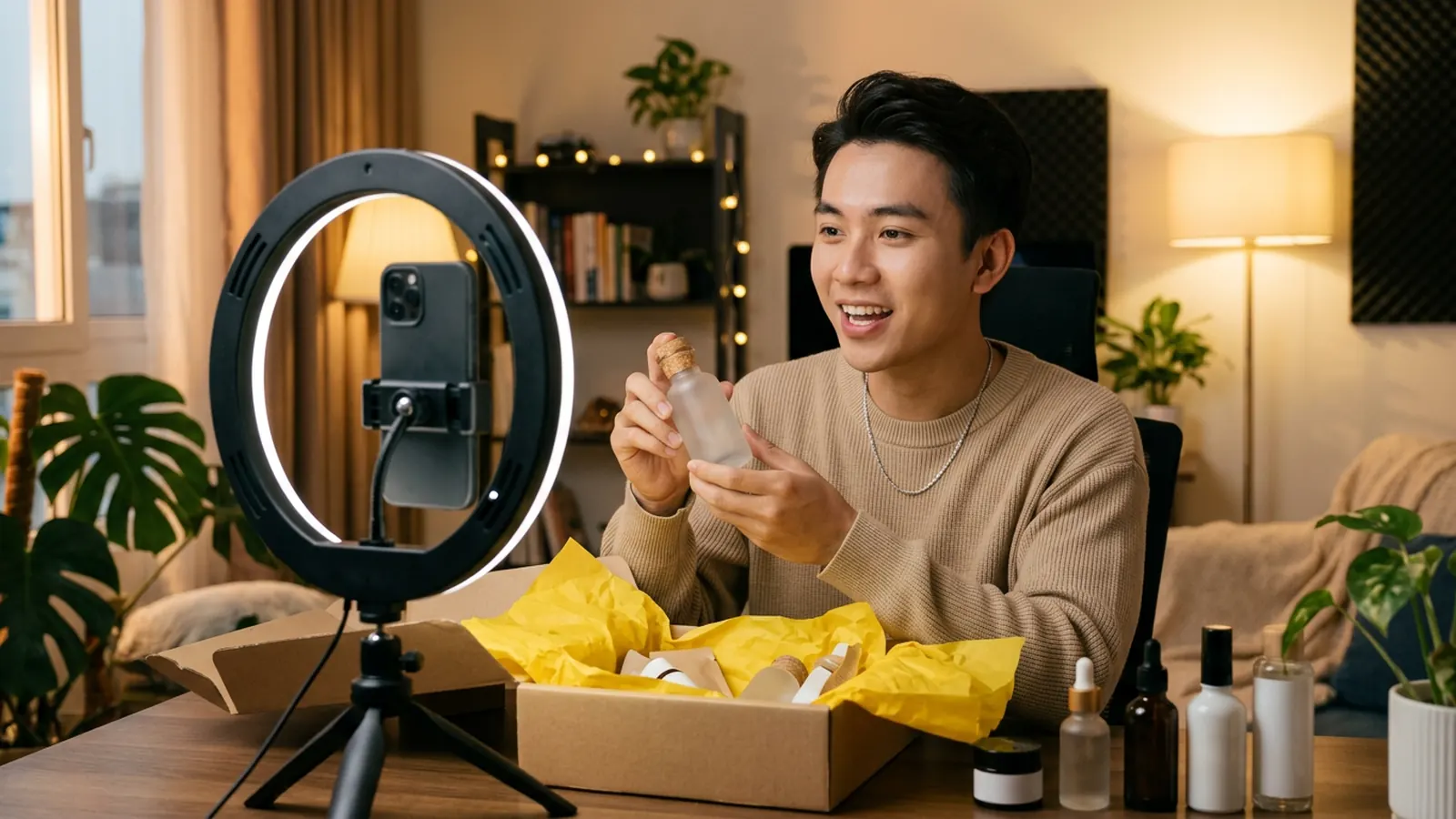
A KOC is a creator who speaks as a consumer. Their videos show unboxing, texture tests, before and after, honest pros and cons, price comparisons and how a product fits into daily life. The audience is often smaller, but it trusts the creator because the content does not feel staged.
KOCs have become central in Vietnam because shopping now happens inside the content. On TikTok Shop a creator can attach a product to a video or sell during a livestream, and affiliate programmes on TikTok Shop and Shopee let creators earn commission on orders. That turns KOC content into a sales channel, not just awareness.
4. Nano, micro, macro, mega: how creator tiers work
Tiers describe audience size, not role. A nano creator can be a KOL in a tiny niche, and a macro creator can make KOC-style reviews. Thresholds also differ between agencies and platforms, so treat any tier table as a working convention, not a standard. Always check average views and audience location, not just the follower count.
- Nano: under about 10,000 followers. Close communities, high trust, often open to gifting or product-plus-fee deals
- Micro: roughly 10,000 to 100,000. The sweet spot for niche reach with consistent content quality
- Macro: roughly 100,000 to 1,000,000. Broad reach, professional production, managed by agencies or managers
- Mega and celebrity: above 1,000,000. Mass awareness, the highest negotiation complexity and the strictest scheduling
5. When should you use KOLs?
Use KOLs when the campaign needs authority or attention that you cannot buy in small pieces. The clearest cases are launches, premium or high-consideration products, and categories where trust in expertise matters, such as skincare actives, supplements, finance or baby care.
- New product or brand entering the market and needing fast awareness
- High price or high risk purchase where buyers want expert reassurance
- Repositioning a brand or entering a new audience segment
- Campaign moments: mega sale days, festivals, Tết, back to school
6. When should you use KOCs?
Use KOCs when you need proof at scale. If buyers already know the category and want to see the product on a real person, real skin or in a real kitchen, many authentic reviews will usually do more than one polished endorsement.
- Everyday products with frequent purchase: FMCG, beauty, fashion, home, snacks
- TikTok Shop and Shopee campaigns with affiliate commission or cart links
- Seeding a new product to create social proof before or after a KOL wave
- Testing messages and hooks cheaply before scaling paid ads
7. How do you mix KOL and KOC in one campaign?
The most reliable structure is a pyramid with timing. A small number of KOLs create the moment, a larger group of micro creators spreads the message into niches, and a wide base of KOCs turns attention into proof and orders. Each layer gets its own brief, its own KPI and its own payment model.
Example: a skincare brand launching a new serum on TikTok Shop. Week 1: two beauty KOLs publish hero videos explaining the active ingredient. Week 1 to 2: eight micro creators post routines and comparisons. Week 2 to 4: forty KOCs post texture tests and seven-day diaries with the product attached, paid with product plus a fee or commission. Paid ads then boost the best KOC videos with the creator's authorisation.
- Top layer, KOL: awareness and credibility, flat fee, tight approval
- Middle layer, micro: niche reach and education, flat fee or hybrid
- Base layer, KOC: proof and conversion, gifting, commission or hybrid
- Amplification: boost winning videos with paid media using agreed usage rights
8. How should you split budget between KOLs and KOCs?
Split budget by goal, not by habit. If the objective is awareness for something new, weight the plan toward KOLs and macro creators. If the objective is sales of a known product, weight it toward micro creators and KOCs with commerce links. Mixed objectives need a mixed plan, with each layer measured against its own KPI.
Do not forget usage rights for paid amplification, or operations: samples, shipping, coordination and payments scale with the number of creators, not their audience size. We do not publish price ranges because quotes move with platform, format, rights and timing; the cost drivers are explained in our guide to KOC booking cost.
KOC booking cost: what drives creator feesHow to build a creator campaign budget
9. What changes in operations when you add KOCs?
Adding KOCs changes the shape of the work from a few deep relationships to a pipeline. Five KOL contracts can live in a spreadsheet and a chat group. Fifty KOC collaborations need stages, owners and deadlines, or drafts get lost, products ship to the wrong address and payments go out late.
The minimum structure is a booking pipeline where every creator moves through the same stages, one brief template per layer, a single approval flow with versioning, and a payment reconciliation step that matches what was delivered against what was agreed. This is exactly the work Roster and KOC OS were built for at DaisyLexi: Roster for the creator database and booking pipeline, KOC OS for tasks, content versions, approvals and payment checks.
- Pipeline stages: shortlisted, contacted, negotiating, confirmed, product sent, draft received, approved, posted, paid
- One brief per layer: KOL briefs set the message; KOC briefs set mandatory points and leave room for natural delivery
- Approval with versions so feedback is never lost in chat
- Track links, codes and post URLs per creator from day one
Build a KOC booking pipelineContent approval workflow for creatorsCreator brief checklist
10. KOL vs KOC: how do you measure each one?
Measure each layer against the job you gave it. Judging a KOL on direct orders, or a KOC on reach, leads to the wrong conclusions and the wrong next booking.
For KOLs, look at reach, view-through, comments that show the message landed, branded search after posting, and how the hero asset performs in ads. For KOCs, look at saves, shares, link clicks, add-to-cart and orders where the platform shows them, and which hooks repeat across top performers.
11. Do KOLs and KOCs have the same legal duties in Vietnam?
Yes, in the sense that both are covered when they advertise. Under the amended Law on Advertising (Law No. 75/2025/QH15, in force since 1 January 2026), anyone who directly advertises, recommends or endorses a product online is an "advertisement conveyor" (Article 2.8), and influencers as defined under consumer protection law carry extra duties in Article 15a.3: verify the advertiser, check product documents, do not present a product they have not used or do not understand, and announce the advertising right before and during the content.
Article 23 of the same law also requires social network users who advertise to mark sponsored content so it can be distinguished from their other posts. Platforms add their own rules: TikTok requires its content disclosure setting for promotional posts, and Meta requires the Paid partnership label on branded content, including gifted products and affiliate links. A small KOC paid only in products is not outside these rules, so build disclosure into every brief and contract, not only the KOL ones. This is general information, not legal advice.
12. Common mistakes when choosing between KOL and KOC
Most failed creator campaigns we audit did not pick the wrong type of creator. They picked the right type and gave it the wrong job, brief or timing.
- Booking by follower count without checking average views and audience location
- Giving KOCs a KOL-style script, which kills the authenticity you paid for
- Running KOCs with no hero content or search demand to support them
- Forgetting usage rights, then being unable to boost the best videos
FAQ
Frequently asked questions
Is a KOC just a smaller KOL?
Not exactly. Size and role are different things. A KOC is defined by consumer-style, experience-based content; many are small, but some have large audiences and still speak like a customer. A small expert with a niche following can be a KOL.
KOL vs KOC: which converts better?
For products people already understand, KOC content tied to a cart or affiliate link usually has the more direct path to orders. KOLs tend to win on awareness and credibility, which lifts conversion across all other channels. Measure each against its own goal rather than comparing them on one metric.
Can I pay KOCs only with free products?
Gifting is common with nano creators, but it is still an exchange of value, so disclosure rules apply and you should still agree deliverables in writing. Many KOCs now expect a fee, commission or both, especially for video and livestream work.
Do KOCs need to disclose sponsored content in Vietnam?
Yes. The amended Law on Advertising (Law No. 75/2025/QH15) covers anyone who advertises or recommends products online, and requires sponsored content on social networks to be marked. Platform rules on TikTok and Meta also require disclosure for paid, gifted and affiliate content.