Korean Brands in Vietnam
Launching a Korean F&B Franchise in Vietnam: An 8-Week Creator Plan
A Korean F&B brand launch in Vietnam rarely fails for lack of good food. It fails when nobody local knows the store has opened, when the opening week is a single spike, or when headquarters and the local partner each assume the other is paying for creators. This guide gives an eight-week creator plan for a franchise store opening, with a clear split of responsibilities between the Korean headquarters and the Vietnamese master franchisee. It describes operating practice, with no invented figures and no claims about specific brands.
Short answer
How do you launch a Korean F&B franchise in Vietnam with creators?
Run eight weeks: two weeks of pre-opening teasers, an opening week with local food reviewers, a delivery-app push, second-visit content and a review of results. Localize the menu story for Vietnamese guests, track visits with creator vouchers, and agree in writing whether headquarters or the master franchisee pays for creators.
- Weeks 1 to 2: teasers and creator shortlist before the doors open
- Week 3: soft-opening tasting for a small group of creators
- Week 4: opening week with food reviewers and local KOCs
- Weeks 5 to 6: delivery push and everyday KOC visits
- Weeks 7 to 8: second-visit content, review and decision on the next phase
- Agree who funds creators and who owns the content before you book anyone
1. Why does a Korean F&B brand launch in Vietnam need its own plan?
A Korean F&B brand launch in Vietnam needs its own plan because Korean brand recognition does not transfer automatically to local guests, and many expansions run through a master franchisee who controls the store while headquarters controls the brand. Creator campaigns sit in the gap between the two.
The plan below assumes a first store or a first cluster of stores in a city such as Ho Chi Minh City or Hanoi. Adjust the timeline to your real opening date and let the venue's readiness set the pace.
2. Who owns what: headquarters or master franchisee?
Write the split down before you book a single creator. A common arrangement is that headquarters owns the brand story, assets and approval of claims, while the local partner owns creator budget, store operations and local relationships. Your franchise agreement may say otherwise, so treat this as a checklist, not a rule.
Decide who signs creator contracts, who pays, who approves content, who owns usage rights and who answers comments. Without that, approvals stall and creators wait weeks for replies.
- Brand story and visual assets: usually headquarters
- Creator budget and payment: agree explicitly
- Content approval: name one decision maker with a turnaround time
- Usage rights: define channels, duration and paid use
- Store readiness and staffing for creator days: local partner
3. How do you localize the story for Vietnamese guests?
Korean food is already familiar to many Vietnamese diners, so the job is to explain why your store is worth choosing, not to explain Korean food in general. Focus on the signature dish, the price positioning, the group-dining occasion and what is different from the store nearby.
Invite local creators to react honestly to the menu before the opening so you can adjust portion size, spice level and set combinations. Our localization guide covers how to adapt a Korean brand message for Vietnam.
4. Weeks 1 and 2: what happens before the doors open?
Use the pre-opening period to build curiosity and recruit creators. Post teaser content from the construction or kitchen setup, announce the opening date and the neighborhood, and invite a shortlist of local creators to a tasting.
Choose creators by audience location first. Review their recent food videos and ask for audience data. A creator whose followers live near the store is worth more than a larger creator across the country.
5. Week 3: how should the soft-opening tasting run?
The soft opening is a rehearsal. Invite a small group of creators, serve the standard tasting menu and watch how the kitchen handles the load. If service is slow on a quiet day, it will be slower on opening week.
Collect honest feedback from creators privately and fix what you can. Agree on posting dates so videos land during opening week, not before the store can serve people.
6. Week 4: how do you run opening week?
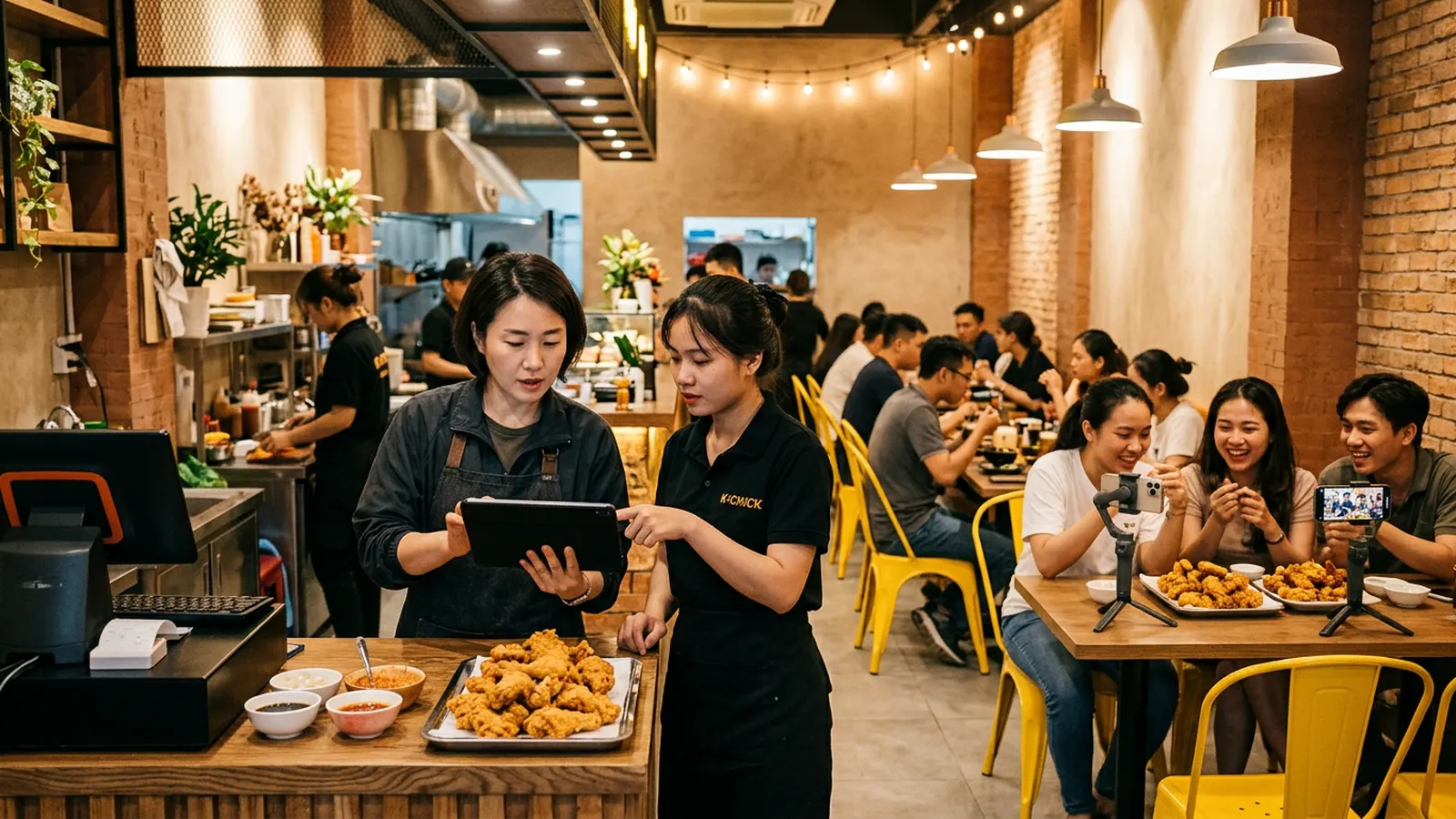
Opening week should combine three creator types: food reviewers for a polished first look, local KOCs for casual visits, and, if the budget allows, one larger creator for reach. Space visits across the week so kitchen and staff are not overwhelmed.
Give each creator a unique voucher or phrase, so staff can log redemptions. Make sure each creator knows the address, nearest parking, opening hours and the line to use for advertising disclosure.
7. Weeks 5 and 6: how do you push delivery?
After the opening buzz, delivery becomes the second sales channel. Ask creators to show how to order from the store's delivery listing and to film dishes that travel well. Offer a small first-order incentive only if your operations team can honor it.
Do not ask creators for fake ratings. Platforms have their own review policies, and honest ratings from real customers last longer. Watch the listing's real feedback and fix packaging or timing problems early.
8. Weeks 7 and 8: how do you drive second visits?
Second-visit content shows the store after the launch noise has died down. Invite everyday KOCs to bring friends, try a different dish or visit at a different time, so the store looks like a regular place rather than a one-time event.
Review results at the end of week 8 by creator and by video: redemptions, new guests who mention a creator, delivery orders, comments and any complaints. Decide which creators to keep and whether to expand to another store.
9. How should you budget and report?
Split the budget into creator fees, food and beverage cost for tastings, content production, any paid boost on top-performing videos and a reserve for repeat visits. We do not give prices because fees depend on audience, usage rights and season.
Report weekly to both headquarters and the local partner using the same template, so each side sees the same numbers. Our budget guide shows how to build the plan.
10. What compliance points apply?
Vietnam's Advertising Law, as amended by Law 75/2025/QH15 and in force from 1 January 2026, adds Article 15a. It requires influencers to announce an ad immediately before or during the content and to check the advertiser and the product documents. Give creators the disclosure wording and the store's business information.
Food and health claims, imported ingredients and any promotions have their own rules that we have not verified here. Confirm them with a Vietnamese legal adviser before launch.
FAQ
Frequently asked questions
When should creator work start before a store opening?
About two weeks before the opening for teasers and shortlisting, with a soft-opening tasting one week before. Adjust to the store's real readiness.
Should headquarters or the franchisee pay for creators?
There is no universal answer. Write the split into the agreement before booking and name one approver for creator content.
Do Vietnamese guests need Korean-style marketing?
Mostly no. Explain your signature dish and why the store is worth visiting in local terms, and let Vietnamese creators tell it in their own voice.
How many creators should we book for opening week?
Start with a small group your kitchen can serve well, then add more in later weeks if service and results are strong.
Can we give creators free meals?
Yes, but gifted content must be disclosed as advertising under Article 15a of the amended Advertising Law. Put the wording in the brief.