Creator earnings
How Much Do KOCs Make in Vietnam? Income by Tier and Stream
Every creator group chat in Vietnam asks the same question: how much do KOCs actually make? The honest answer is that there is no fixed salary, because KOC income is a stack of separate streams rather than one paycheck. What you earn depends on your follower tier, your niche, and how many of the streams below you can stack at once. This guide breaks each stream down with the ranges Vietnamese campaigns actually pay, worked monthly scenarios you can adapt, and the tax rule that changes what lands in your account.
Short answer
How much do KOCs make in Vietnam?
There is no reliable public average. Nano KOCs usually start on product-only or affiliate deals worth a few hundred thousand VND a month. Micro KOCs commonly quote a few hundred thousand to a few million VND per video, and creators who earn a steady income typically combine affiliate commission, two to five paid bookings a month, occasional seeding and the odd livestream slot or ambassador retainer.
- Affiliate commission: commonly 10 to 20 percent of the item price, paid only on settled orders
- Paid bookings: a flat fee per deliverable that scales with tier, niche and usage rights
- Seeding and freecast: product value first, commission only when a sale happens
- Livestreams: slot fee, commission or a hybrid of the two
- From 1 July 2026, payers withhold 10% tax on single payments of 5 million VND or more
1. Is there a real average KOC income?
No. There is no reliable industry figure for KOC earnings in Vietnam, and anyone quoting one is describing their own campaigns or platform. Income varies by follower tier — nano under about 10,000, micro roughly 10,000 to 100,000, macro roughly 100,000 to 1,000,000, mega above 1,000,000 — and by which income streams a creator can combine.
The more useful question is not 'what does a KOC earn' but 'which streams does a working KOC stack in a normal month'. A nano KOC might earn only free product and small commissions, while an established micro KOC stacks flat fees, settled commission and a retainer. The sections below give the ranges campaigns actually pay, so you can place yourself honestly.
2. Stream one: affiliate commission, where most KOCs start
TikTok Shop affiliate is the lowest-barrier income stream: you apply as a creator, pick products in your niche, put the product link in your videos and earn a percentage of each settled order. Commission rates commonly run at 10 to 20 percent of the item price — a 400,000 VND skincare set at 15 percent pays you 60,000 VND per order.
The catch is that commission is paid on settled orders, not clicks. Attributed GMV shrinks when buyers cancel or return: an example used elsewhere on this site has 50 million VND of attributed sales settling to a 44 million VND commission base after 6 million in cancellations and refunds. Before you count commission as income, check how many of your orders actually settle.
TikTok Shop affiliate with KOCsHow brands set affiliate commissionAttributed GMV vs settled sales
3. Stream two: paid bookings, flat fees per deliverable
A paid booking is a flat fee for agreed deliverables — usually one video, sometimes a bundle. Nano KOCs typically start on product-only or affiliate-only deals; micro KOCs can charge flat fees, and common ranges in Vietnam run from a few hundred thousand to a few million VND per video depending on niche and deliverables.
Two quotes at the same follower count can differ a lot, because brands price the scope, not just the audience: number of deliverables, revision rounds, posting dates and especially usage rights. On TikTok, creators can grant a brand ads authorisation so the video runs as a Spark Ad — TikTok's default authorisation is 60 days, and rights like that belong in the written fee, not an afterthought.
4. Stream three: seeding and freecast, product first and commission only
Seeding means a brand sends you a product and hopes you post — sometimes with no obligation, sometimes with an opt-in agreement. Freecast sits between gifting and a paid booking: you agree to post, but you are paid only through commission on what sells.
Neither pays cash upfront, so treat them correctly: early on, product and low commission are how you build the portfolio that earns real fees later. Once your reviews demonstrably convert, you have the evidence to ask for flat fees instead.
5. Stream four: livestream hosting — slot fee, commission or hybrid
Live commerce deals fall into three shapes. A flat slot fee pays the host for their time whatever sells. A pure commission pays a share of sales and pushes the risk onto the host. A hybrid combines a smaller fixed fee with commission — a common middle ground for newer products.
Hosts are chosen from recent live data rather than follower counts: average live viewers, watch time and what previous sessions actually sold. If you want live work, your evidence is your own live statistics, and from 1 January 2027 platforms must electronically verify hosts' identity before livestream sales, so keep your documents ready.
Livestream host fee structuresLive commerce models in Vietnam
6. Stream five: ambassador programs and retainers
The steadiest KOC income is not a viral video — it is an always-on arrangement. Ambassador programs organise creators into tiers with a monthly quota, regular product drops and a commission ladder, so the monthly income is predictable in a way one-off bookings never are.
Retainer-style deals work similarly: a brand keeps you on a monthly arrangement for a fixed number of deliverables. For creators, the value is a floor you can plan around; for brands, it is a bench of proven creators instead of cold outreach. These deals usually come only after a few successful paid or freecast collaborations.
7. Stream six: UGC content made for ads
UGC work flips the model: the brand buys your production, not your reach. A skincare brand might pay for raw review footage it edits and runs from its own ad accounts, so a creator with 4,000 genuine followers can earn on production quality alone.
UGC is priced per deliverable plus usage rights — where the content runs, for how long and whether it becomes a Spark Ad. That makes it a useful parallel stream for creators whose audience is small but whose videos convert.
8. Illustrative monthly scenarios by tier
The scenarios below are illustrative examples built from the ranges above — not quotes, and not averages. Your numbers will differ by niche, season and how reliably your content sells.
Each scenario stacks the streams a creator at that level can realistically combine. The point is the shape of the stack: affiliate alone is thin, and income only looks like a living once flat fees and predictable arrangements join it.
- Nano (under 10K followers): affiliate only — about 30 settled orders x 60,000 VND ≈ 1,800,000 VND, plus free product; realistically under 2 million VND in cash
- Micro (10K–100K): three paid videos at 1,500,000 VND each = 4,500,000, plus settled affiliate ≈ 5,000,000 — around 9.5 million VND gross
- Established (high micro to macro): five bookings at 3,000,000 VND each = 15,000,000, plus affiliate ≈ 8,000,000 and one livestream slot ≈ 5,000,000 — around 28 million VND gross
9. What quietly shrinks the payout
The number on the deal memo is not the number that arrives. Commission is settled after cancellations and refunds, so a strong GMV screenshot can shrink by a double-digit share before your percentage applies. Flat fees shrink differently: unpaid revision rounds, a scope that grows without a new price, and payment terms that stretch for weeks.
Protect yourself the boring way. Put deliverables, revision limits and payment dates in writing. Track which of your posts actually settle orders. And when you quote a fee, remember that a single payment of 5 million VND or more now triggers 10% provisional withholding — quote the gross figure and know what the net will be.
10. Tax: the 10% withholding rule on KOC payments
From 1 July 2026, Decree 253/2026/ND-CP requires an organisation paying remuneration to a resident individual without a labour contract — or with one under three months — to withhold 10% personal income tax when a single payment is 5 million VND or more. Below 5 million per payment, the payer withholds 10% only if you ask. The 10% is provisional and is settled at annual tax finalisation, where overpayment can be refunded.
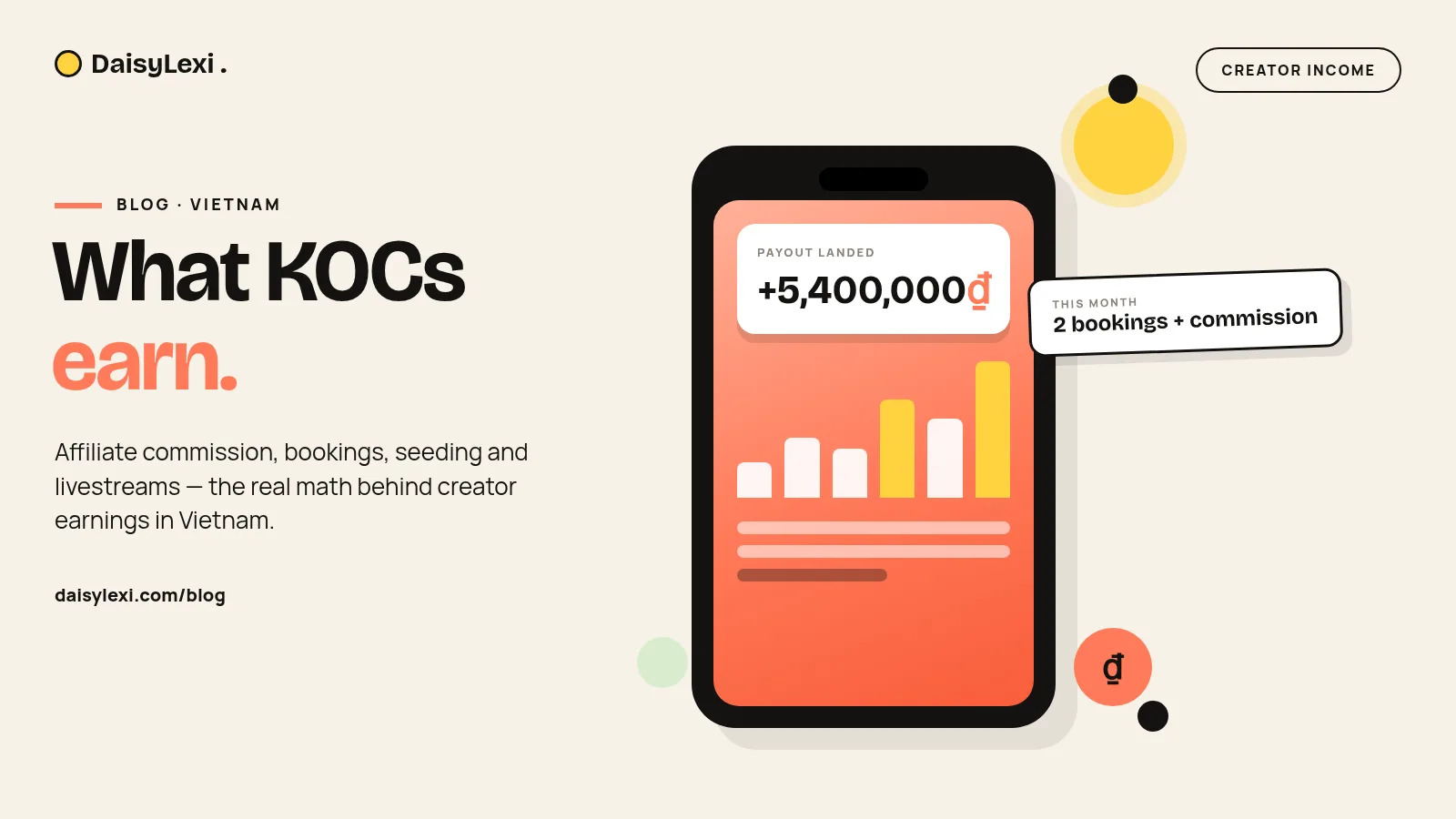
Worked example, matching the site's tax guide: a brand agrees a 6,000,000 VND fee with an individual KOC for one video. The payment is above 5 million, so the payer withholds 600,000 VND, the creator receives 5,400,000 VND and the withheld amount is credited at finalisation. Whether the rule applies to you depends on how you are engaged — individual, household business or through a company — so confirm your setup with a Vietnamese tax adviser. This is general information, not tax advice.
KOC withholding tax in detailHow brands pay creators from abroad
11. How to raise what you charge
Brands pay for proof, not potential. A media kit with your follower count, average views, top three videos, niche and rates turns a maybe into a yes faster than a bigger follower count — a 5,000-follower creator with genuine reviews regularly beats a 50,000-follower account with bought followers. On TikTok Shop, sellers can filter for 'reliable creators' — the top 20% by ratio of samples received to content posted — so every sample you accept and actually post about moves your number.
Pricing levers work on scope, not pressure: bundles of several videos, longer collaborations, tighter revision limits and clear usage rights all change the fee honestly. Fast, reliable posting builds the repeat relationships that carry a full-time income.
How to become a KOC, step by stepTrading scope, not pressureKOC communities on Zalo
12. Red flags and when to walk away
A legitimate brand never charges a creator to join a campaign — fees flow toward you, not away. Be careful with unpaid 'test' work requested at scale, with verbal deals that never reach a contract, and with briefs that grow revisions or usage rights without growing the fee.
Watch the legal side too: paid content must be announced as advertising under the amended Advertising Law, and a brand that asks you to skip disclosure is asking you to carry the risk. When a deal fails your checklist — vague scope, no contract, no disclosure, slow payment history — the professional move is to trade scope or walk away.
Contract checklist for KOL and KOC dealsHow booking works end to end
FAQ
Common questions about KOC income
Can a KOC make a full-time income in Vietnam?
It is achievable but rare at nano scale. Most creators who do it full-time stack several streams — affiliate commission, two to five paid bookings a month, seeding and occasional livestream or ambassador arrangements — and the income curve typically steepens around months four to six once a portfolio and repeat brand relationships exist.
How much can a micro KOC charge per video?
Common ranges in Vietnam run from a few hundred thousand to a few million VND per video, depending on niche, deliverables, revisions and usage rights such as whether the brand can run the video as an ad. Price the scope in writing, not just the follower count.
Do KOCs have to pay tax on their income in Vietnam?
From 1 July 2026, a payer must withhold 10% personal income tax on a single payment of 5 million VND or more to a resident individual without a labour contract or with one under three months. The 10% is provisional and settled at annual tax finalisation. Whether it applies to you depends on your setup — confirm with a Vietnamese tax adviser.
Is a free product a fair payment for posting?
Product value is real but it does not pay bills. Seeding and freecast deals make sense early, when each sample builds the portfolio and posting record that earns flat fees later; once your reviews demonstrably convert, that record is your evidence for asking for cash fees.
How soon can a new KOC start earning?
Affiliate commission can arrive within weeks of your first linked videos, but expect the first one to three months to stay small — commonly a few hundred thousand VND a month plus free product. The curve steepens around months four to six.
Should a creator ever pay a brand or agency to join a campaign?
No. Legitimate campaigns pay the creator, not the other way round. A request for a joining fee, a 'deposit' to receive samples, or paid training tied to guaranteed bookings is a red flag — walk away.
Do KOCs get paid for hosting livestreams?
Yes, under three common structures: a flat slot fee for the host's time, a commission on what the session sells, or a hybrid of a smaller fixed fee plus commission. Compare deals on the same basis — fixed cost, variable cost and what you are paid if sales are low.