Livestream Commerce
Livestream Sales Script and Run-of-Show Template for Vietnam
A good live selling session feels spontaneous to the viewer and is tightly planned behind the camera. This guide gives you a run-of-show you can adapt for a two-hour TikTok LIVE or Shopee Live in Vietnam: what happens in each block, who does what, and what to check before you go live, including the identity and truthfulness points under the 2026 e-commerce rules. Timings are a starting framework, not benchmarks. Adjust them after your first sessions using your own numbers.
Short answer
What should a livestream sales script and run-of-show include?
A run-of-show divides the session into timed blocks: warm-up, hero product, voucher drops, Q&A and repeated re-hook cycles, with named roles for host, co-host, operator and comment moderator. Add a claim sheet, stock and price table, and a pre-live checklist so the host never improvises facts.
- Timed blocks with one goal each
- Roles: host, co-host, operator, comment moderator
- Hero product first, then rotation with repeat cycles
- Voucher drops planned at set moments, not at random
- Claim sheet, real price and stock table at the desk
- Pre-live checks: host verification, account, stock, vouchers
1. Why do you need a run-of-show for a live session?
Live viewers come and go all the time. A viewer joining at minute 40 needs the same hook as one joining at minute 2, which is why good sessions repeat key offers in cycles instead of running as one long story.
A written run-of-show also lets a team hand over between hosts, keeps claims consistent and gives you something to review afterwards. Without one, the session depends on one person remembering everything.
2. Which roles do you need on the team?
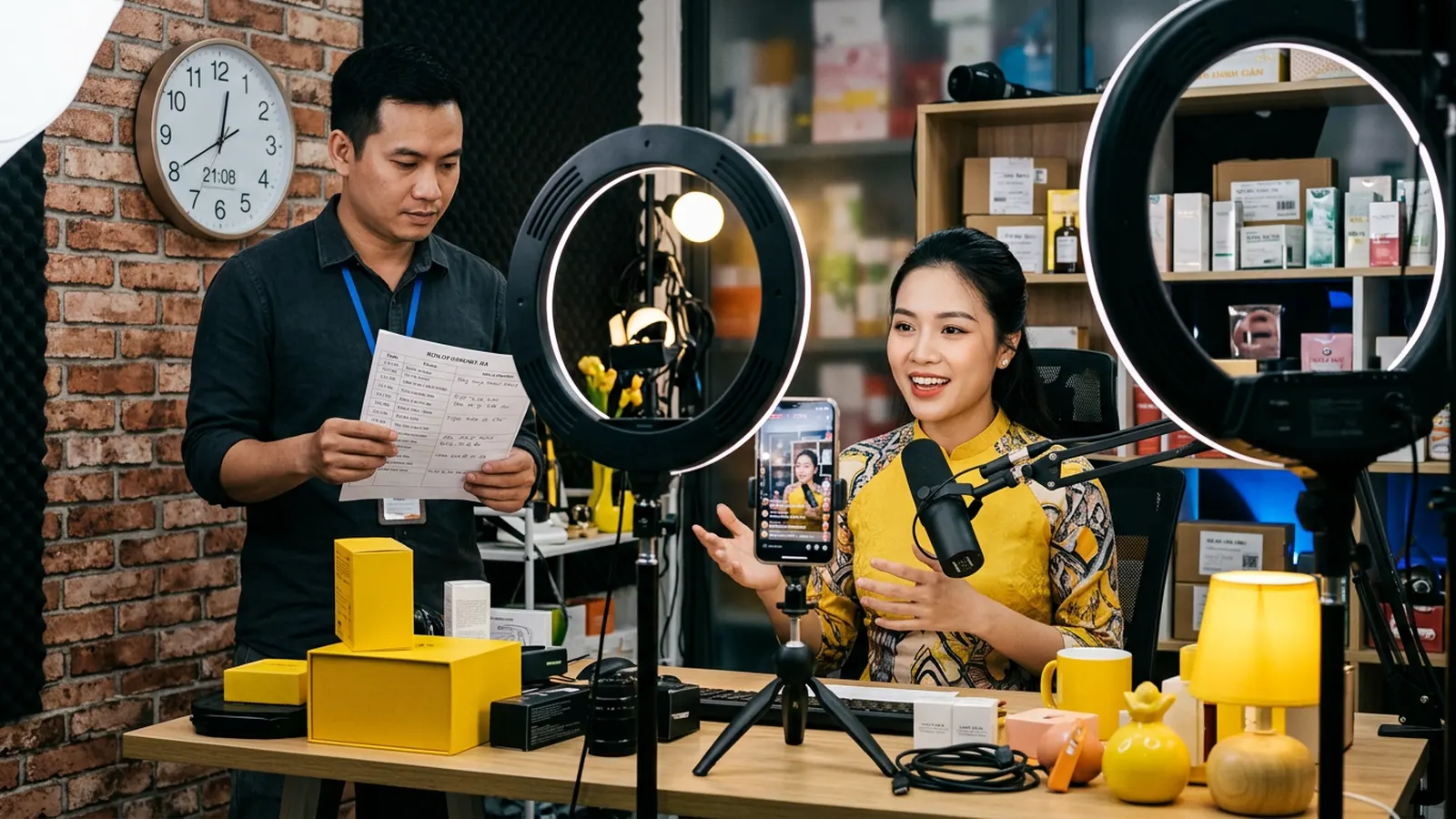
A small session can run with two people, but the jobs still exist. Name who does each one before you start.
- Host: speaks to camera, demonstrates, follows the claim sheet
- Co-host: asks the questions viewers would ask, keeps energy up
- Operator: pins products, changes vouchers, watches stock
- Comment moderator: answers questions, flags problems to the host
- Producer: watches the clock and signals the next block
3. What is a sample two-hour run-of-show?
Use this as a starting skeleton and change the lengths to fit your product range.
- 0:00-0:10 warm-up: greet, state the session schedule, tease the hero offer
- 0:10-0:30 hero product: demonstration, proof, price and first voucher
- 0:30-0:50 second and third products with short demonstrations
- 0:50-1:00 first re-hook: recap the hero offer for new viewers
- 1:00-1:30 rotation: bundles, comparisons, answers to questions
- 1:30-1:45 second voucher drop and stock reminder
- 1:45-2:00 final recap, thanks and next session announcement
4. How should the warm-up work?
The first minutes set the tone and let early viewers gather. Greet by name, say what will be covered and when the main offer arrives, and ask a simple question in the comments so the room starts talking.
Do not hide the price and the voucher until the end. State the structure of the session so people know why to stay.
5. How do you present the hero product?
Lead with the product that has the strongest demonstration and the best margin. Show it in use, handle the most common objection, state the real price, voucher terms and what is in the box.
Keep the claim sheet in front of the host. Only say what you can support, and avoid improvised promises about results, origin or availability.
6. When should voucher drops happen?
Plan voucher moments in the run-of-show, for example one near the hero product and one later when attention dips. A planned drop lets the operator prepare the voucher and the host announce terms accurately.
Check voucher funding, limits and expiry before the session. Brands that split costs with a distributor or shop owner should agree funding beforehand.
7. What is a re-hook cycle?
A re-hook is a short, repeated block that restates the main offer for viewers who just joined. It usually includes who you are, what the offer is, how long it lasts and how to claim it.
Schedule a re-hook every fifteen to twenty minutes as a starting point and adjust after you read your own viewer retention data.
8. How do you handle questions and objections?
Prepare answers to the questions you expect: sizing, ingredients, shipping time, returns and how to use the voucher. The comment moderator can pin or read them out so the host does not lose the flow.
If a question needs an answer you do not have, say that you will check and follow up. A wrong answer live is harder to fix than a short delay.
9. What should you check before going live under the 2026 rules?
Law 122/2025/QH15 on E-commerce and Decree 248/2026/ND-CP took effect on 1 July 2026, according to Vietnam's Ministry of Industry and Trade (MOIT). MOIT states that individuals who run livestream sales, including KOLs and KOCs, must complete identity verification before broadcasting sales sessions, and that product presentations must be truthful about function, quality, origin, price, warranty and availability.
Treat these as checklist items, not as a legal opinion. We have not cited individual articles here; read the current official texts or ask a Vietnamese lawyer for regulated products such as cosmetics or supplements.
- Host account verified for selling on the platform
- Claim sheet limited to statements you can support
- Real price, voucher terms and return policy on the desk
- Real stock count confirmed with the warehouse
- Affiliate links and codes assigned to the right people
- No instruction to move buyers to private chat or off-platform payment
10. What should you do right after the session?
Export the session data the same day: peak and average viewers, retention, orders, GMV and voucher use. Note which block produced orders and which lost viewers.
Write three changes for the next session and update the run-of-show. Over a few sessions the plan improves faster than any template.
11. When should you use your own hosts instead of booked creators?
Your own hosts suit daily sessions where you want full control. Booked creators suit launches and peaks where borrowed audience matters. The same run-of-show works for both with a brief that explains the blocks.
FAQ
Frequently asked questions
How long should a TikTok LIVE sales session be?
There is no fixed rule. Many teams start with sessions of around two hours, then adjust based on viewer retention and order data from their own account.
How often should I repeat the main offer?
A repeat every fifteen to twenty minutes is a reasonable starting point because new viewers keep joining. Test it against your own retention data.
Do KOL and KOC hosts need identity verification?
According to MOIT, individuals conducting livestream sales, including KOLs and KOCs, must complete identity verification before broadcasting sales sessions under the new e-commerce rules.
Should the host read a script word for word?
No. Use a script for facts, offers and claims, and let the host speak naturally around them. Word-for-word reading usually sounds stiff and loses viewers.
Can I use this template on Shopee Live?
Yes. The block structure works on any live selling platform. Adapt voucher and pinning steps to each platform's tools.