Creator Growth
Tips for Vietnamese Content Creators: Grow, Sell and Land Brand Deals
These tips for Vietnamese content creators come from the brand side of the table: what we look for when we book KOLs and KOCs, and what makes us rebook them. Growing in Vietnam is less about luck with one viral video and more about running a small business: a clear niche, formats that sell, professional replies to briefs, legal ad disclosure and numbers you can show. Below is the operator-level playbook, plus a section for foreign and Korean creators making content for Vietnamese viewers.
Short answer
What are the best tips for Vietnamese content creators?
Pick one niche and one main platform, open every video with a hook that shows the problem or result, learn TikTok Shop affiliate, keep a simple media kit, answer briefs with a clear plan, disclose ads before and during content as the amended Advertising Law requires, sign contracts with usage terms and track your own results.
- One niche, one main platform, one or two support channels
- Hook in the first seconds, product proof in the middle, clear call to action
- Learn TikTok Shop affiliate rules before chasing commission
- Media kit plus rate card built on pricing factors, not guesses
- Disclose ads before and during content, and use platform labels
- Contracts that define deliverables, usage rights and payment
- Track views, clicks, orders and returns for every post
1. What are the most useful tips for Vietnamese content creators starting out?
The most useful tip for Vietnamese content creators is to treat your channel like a small media business from day one. Brands in Vietnam book creators who are predictable: a clear audience, a recognisable format, on-time delivery and honest results.
When we shortlist KOCs for a campaign, the deciding factors are rarely follower count alone. We look at whether the last ten posts sit in one topic, whether comments come from real buyers asking real questions, whether past sponsored posts were disclosed properly and whether the creator replies to a brief within a working day.
Everything in this guide builds those signals. If you only have time for three things this month, fix your niche, tighten your hooks and write a one-page media kit.
2. How do you pick a niche and a platform in Vietnam?
Pick a niche where you can post at least three times a week for a year without running out of ideas, and where products are bought online. Beauty, mom and baby, home and kitchen, fashion, food, tech gadgets and pets all have active brand budgets and clear products to review.
Then choose one main platform and treat the rest as support. Each platform plays a different role for Vietnamese audiences and for brands.
- TikTok: discovery and short-video selling; the natural home for TikTok Shop affiliate and livestream
- Facebook: fanpages, groups and community trust; strong for local services, F&B and older audiences
- YouTube: long reviews and comparisons that keep getting search traffic; good for tech and education
- Instagram: visual lifestyle, fashion and beauty, often for urban audiences in Ho Chi Minh City and Hanoi
- Zalo: retention, not discovery; use groups or an Official Account to keep loyal followers and buyers close
3. Which short-video hooks and formats sell?
Short videos that sell show a problem, a result or a surprising detail in the first seconds, then prove it with the product in use. Viewers decide very quickly whether to keep watching, so the opening line and first frame matter more than the logo.
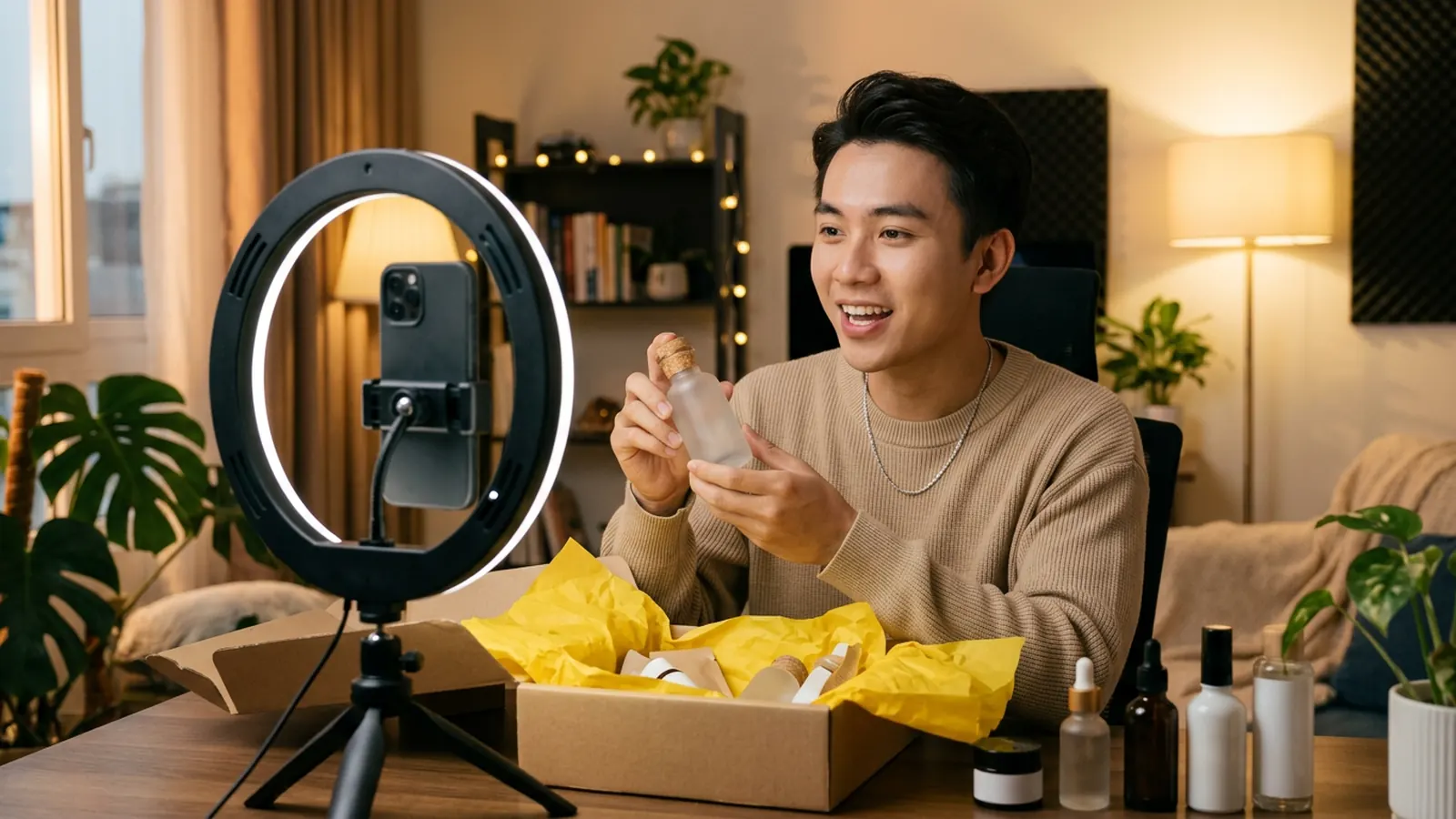
Formats we see convert repeatedly in Vietnamese campaigns include honest reviews after real use, before and after (only when the result is real and allowed for that category), comparisons with your own older routine rather than a named competitor, unboxing with a clear use case, a day-in-the-life with the product placed naturally, and a quick tutorial.
- Problem hook: 'My skin gets oily by noon in Saigon heat. Here is what I changed.'
- Result hook: 'Two weeks using this mop, this is my kitchen floor now.'
- Curiosity hook: 'Nobody told me this rice cooker has a setting for sticky rice.'
- Price-value hook: 'Is this worth it for a student budget? Let me test it.'
- Close with one action: tap the yellow basket, check the link, or save the video
4. How does TikTok Shop affiliate work for creators and KOCs?
TikTok Shop affiliate lets you add products from sellers to your videos or livestreams and earn a commission when viewers buy through your link. Sellers set the commission per product or offer targeted plans to selected creators, and TikTok sets the eligibility rules for who can join.
Before chasing the highest commission, check three things: whether you would actually use the product, whether the seller ships reliably (returns cut your earnings and your credibility) and whether the product category has special content rules. Request samples where the seller offers them, test properly and keep notes on what you tested.
Eligibility thresholds and commission settings change, so read the current rules in TikTok Shop's own affiliate centre rather than relying on old screenshots in creator groups.
5. How do you build a media kit and a rate card?
A media kit is a one or two page summary that lets a brand decide quickly. Keep it short, current and factual, and update it monthly.
Price from factors, not from what a friend charges. Your rate should reflect the work and the value you deliver, and you should be able to explain each line.
- Media kit fields: name and handle, niche, main platform, audience location, age and gender split from your analytics, average views on recent posts, three best-performing examples, past brands, contact
- Pricing factors: format and length, number of revisions, script writing versus brand script, shooting location and props, usage rights and paid-ads permission, exclusivity window, deadline urgency, livestream hours, travel
- Offer packages: one video, a video plus stories, or a monthly bundle
- State what is extra: raw footage, extra revisions, whitelisting, longer usage
6. How should you answer a brand brief professionally?
Answer a brief within one working day with a short plan, your price and any questions. Brands and agencies juggle many creators, and the ones who reply clearly get booked first.
Example reply structure we like to receive: thank them and confirm the product and dates; give your concept in two or three lines with the hook; list deliverables, posting date and platforms; state price, what is included and payment terms; ask for the product documents and key claims; and confirm you will disclose the ad. If something in the brief is unrealistic, say so politely and offer an alternative instead of staying silent.
- Read the do and don't list twice before writing the script
- Ask which claims you may say and which documents support them
- Send the script or storyboard before shooting if the brief asks for approval
- Deliver on time, and warn early if anything slips
7. How do you disclose ads under Vietnam's amended advertising law?
Disclose clearly before and during any paid or gifted content. Law No. 75/2025/QH15 amending the Advertising Law, in force from 1 January 2026, added Article 15a: an influencer who carries advertising must verify the advertiser, check documents about the product, must not introduce a product they have not used or do not understand, and must announce the advertising immediately before and during it.
The amended Article 23 also requires social media users who advertise to mark advertising or sponsored content so it is distinguishable from their other content. Separately, Article 22(3) of the Consumer Protection Law 2023 (Law No. 19/2023/QH15) requires an influencer to notify consumers in advance that they are sponsored.
In practice, combine the law with platform tools. TikTok's Branded Content Policy requires the commercial content disclosure toggle on branded posts, which adds a paid partnership label. Meta's Branded Content Policies require the paid partnership tool and tagging the business partner on Facebook and Instagram, including for gifted products.
- Say it at the start of the video, for example 'Video này có hợp tác với nhãn hàng'
- Keep an on-screen label during the video
- Add the disclosure in the caption and turn on the platform label
- In livestreams, repeat the disclosure as new viewers join
8. What should a creator contract and usage rights cover?
Sign a written contract for every paid collaboration. The amended Article 6 of the Advertising Law says cooperation between parties in advertising must go through an advertising contract, and a contract protects you when a brand asks for more than you agreed.
Usage rights are where creators lose the most money. A brand reposting your video on its page, cutting it into ads or running it from your handle (whitelisting) are different uses and should be priced separately.
- Deliverables, posting dates and platforms
- Number of revisions and approval deadlines
- Usage: organic repost, paid ads, whitelisting, duration and territory
- Exclusivity: which competitors and for how long
- Fee, deposit, payment date, tax withholding and invoices
- Who removes content, and how fast, if a regulator or platform asks
9. How do you avoid TikTok Shop content violations?
Most violations come from exaggerated claims, misleading prices and missing disclosure, not from bad intent. The amended Article 19 of the Advertising Law requires advertising content to be truthful, accurate and clear, without misleading people about features, quality or effects, and the amended Article 8 bans comparing your product with another business's product without lawful supporting documents.
TikTok Shop applies its own content and product policies on top of the law, and violations can lead to video removal, lost commission or account penalties. Read the current policy before posting in sensitive categories such as cosmetics, supplements, health devices and baby products.
- No medical or cure claims for cosmetics and food products
- No fake price anchors or 'only today' when it is not true
- No before and after you cannot prove
- No named competitor comparisons without documents
- Show the product you are actually linking
10. How do you track your own results as a creator?
Track every post in one sheet so you can prove value and spot what works. Brands rebook creators who can show results without being chased.
Record the basics on the day of posting, then update at day 7 and day 30. Over a few months you will see which hooks, products and posting times perform for your audience, and you can put real numbers in your media kit.
- Post link, date, platform, format, product and brand
- Views, average watch time, likes, comments, shares, saves
- Link clicks, orders, GMV and returns where the platform shows them
- Commission earned and paid, with dates
- Notes: hook used, what viewers asked in comments
11. Tips for foreign and Korean creators making content for Vietnamese audiences
Foreign and Korean creators can do very well in Vietnam, but only when the content feels made for Vietnamese viewers rather than translated for them. Interest in Korean beauty, food and pop culture is an opening, not a guarantee.
Work with a native Vietnamese editor for captions and on-screen text. Machine translation often gets tone, pronouns and slang wrong, and the amended Advertising Law (Article 18, clause 1a) requires Vietnamese wording in advertising to be clear, easy to understand and accurate. For voice, choose between your own voice with Vietnamese subtitles, a Vietnamese co-host, or a professional voice-over; viewers usually forgive an accent but not confusing subtitles.
- Learn a few natural Vietnamese phrases and use them on camera
- Use Vietnamese captions burned into the video plus a Vietnamese post caption
- Show prices in VND and where to buy locally, not only the Korean price
- Localise examples: weather, skin concerns, food, holidays like Tết
- Pair with Vietnamese KOCs for reaction or duet content
- Follow the same disclosure rules as local creators
12. What weekly routine keeps creators consistent?
A simple weekly routine beats bursts of inspiration. Plan, batch and review on fixed days so brand work never pushes out your own content.
Example routine: Monday, review last week's numbers and plan five ideas; Tuesday and Wednesday, batch shoot; Thursday, edit and send drafts to brands; Friday, reply to briefs and invoices; weekend, post and answer comments. Adjust the days, but keep the review step.
FAQ
Frequently asked questions
How many followers do I need to get brand deals in Vietnam?
There is no fixed number. Many brands book KOCs with small but engaged audiences for reviews and affiliate sales. A clear niche, real comments and a clean record of past sponsored posts often matter more than follower count.
Do I have to say a video is an ad if I only received a free product?
Treat it as sponsored. Meta's Branded Content Policies treat gifted products as an exchange of value, and Vietnamese law requires influencers to announce advertising and sponsorship. Disclose before and during the content.
Which platform is best for new Vietnamese creators?
For selling products, TikTok is usually the fastest place to learn because of short video and TikTok Shop affiliate. For local services or community-led niches, Facebook can work better. Choose one main platform and use others for support.
How should I set my rates?
Build your rate from factors: format, effort, usage rights, exclusivity, deadlines and revisions. Check your recent average views and results, and price extras such as paid-ads usage separately.
Can a foreign creator work with Vietnamese brands?
Yes, especially in beauty, food and travel. Localise captions with a native editor, show local prices and availability, follow Vietnamese disclosure rules and agree on payment and tax handling in the contract.