Paid Amplification
TikTok Spark Ads and Partnership Ads: Boost Creator Content the Right Way
The best-performing ad in your campaign may already exist: it is the TikTok a KOC posted last week. Spark Ads and Partnership Ads are the tools that let you put paid budget behind that organic creator video while keeping its native feel, its comments and its attribution. This guide explains how they work, what to sort out with creators before you spend a dollar, and how to measure whether amplification actually paid off.
Short answer
What are TikTok Spark Ads and Partnership Ads?
Spark Ads are TikTok's native ad format that boosts an existing organic post from a creator or brand account, using a spark code the account owner authorizes. Partnership Ads are Meta's equivalent for Facebook and Instagram, where a creator grants a brand permission to run their organic post as an ad. Both keep the content's native comments, shares and engagement signals while the brand pays for reach.
1. What Spark Ads and Partnership Ads actually are
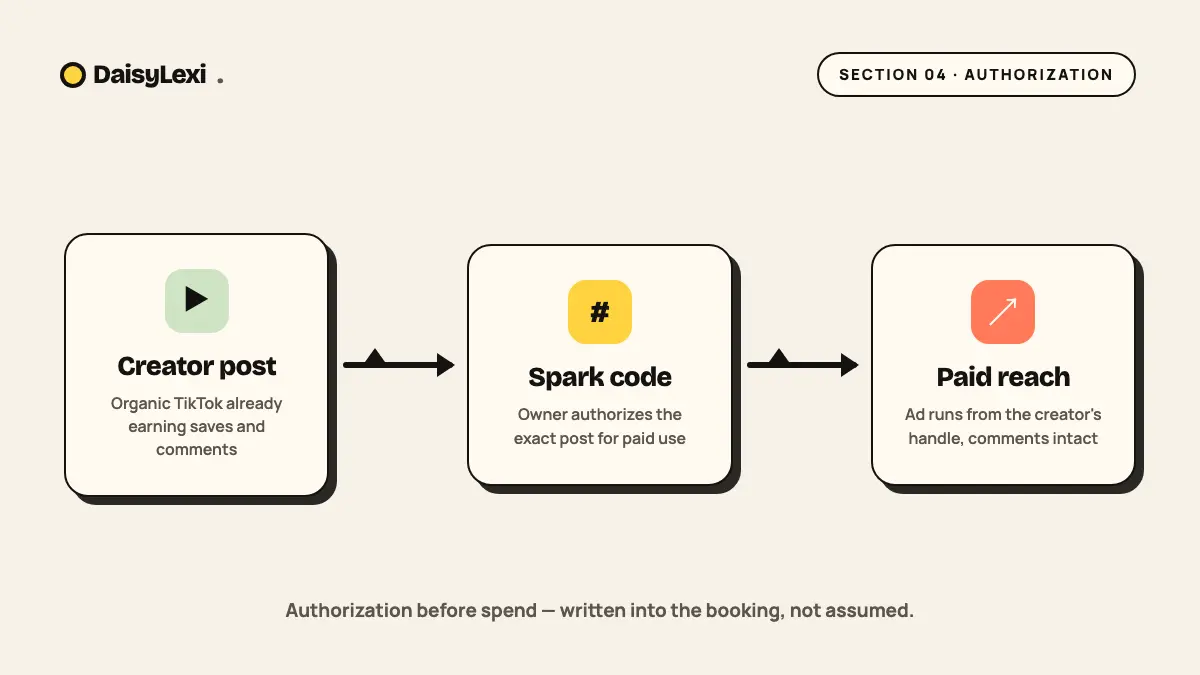
A Spark Ad is not a new video you upload to Ads Manager. It is an existing TikTok post — usually made by a creator — that the post owner authorizes for promotion. The ad runs from the creator's handle, keeps the original caption, comments and likes, and can even keep collecting organic engagement while the paid campaign is live. TikTok calls the authorization a spark code.
Partnership Ads work the same way on Meta. A creator grants a brand an ad code (sometimes called a partnership ad code or whitelisting permission) that lets the brand run the creator's existing Facebook or Instagram post as an ad from the brand's ad account. The post still shows the creator as the author, and Meta labels it as a paid partnership.
Read how usage rights and whitelisting fit into creator contracts
2. Spark Ads vs Partnership Ads vs plain UGC-style ads
The difference matters for cost and control. A plain ad built from creator footage — sometimes called UGC-style creative — is uploaded to your own ad account and runs entirely under your brand identity. Spark Ads and Partnership Ads run under the creator's identity instead, which is why they need permission and why they inherit the creator's audience trust.
In practice, teams run all three. UGC-style ads give full control over edits, captions and landing paths. Spark Ads and Partnership Ads give you the creator's handle, their comments section and the social proof that organic performance already built. Many Vietnam campaigns use Spark Ads for TikTok-first creators and Partnership Ads for Facebook and Instagram-heavy creators, then compare which identity converts better.
3. Why boosted creator content often outperforms brand ads
Paid social has been shifting toward creator-native formats for a simple reason: audiences scroll past anything that looks like an ad. A Spark Ad preserves the handheld framing, casual caption and comment thread that made the organic post work, while the algorithmic distribution of the ad account gives it reach the creator's own followers never gave it.
There is also a measurement advantage. Because the post keeps its organic history, you can see which videos already earned saves, shares and comments before you spend. Boosting proven organic winners is a cheaper test than briefing ten creators and hoping one performs — which is why teams that already run KOC programs get more out of Spark Ads than teams starting from zero.
4. Authorization: spark codes, ad codes and usage rights
Before any spend, the creator must authorize the specific post. On TikTok, the creator opens the post, taps the three-dot menu, chooses Ad settings and generates a spark code — a short authorization the brand pastes into TikTok Ads Manager. Some creators can also authorize directly inside TikTok Creator Marketplace or through a video code request from the brand.
On Meta, the creator shares a partnership ad code from their professional dashboard, or grants permission through a branded content request. Whatever the mechanism, write the permission into the booking or contract: which posts, which platforms, how long, whether you may edit the caption or add a call-to-action button, and what happens to the ad if the creator deletes the post.
5. What to brief creators before they post
Spark Ads amplify whatever the creator publishes, so the creative quality check happens before the post, not in Ads Manager. Brief creators on the product shot, the hook in the first two seconds, whether the brand name needs to appear on screen, and the disclosure line — #ad or the platform's paid partnership label is not optional.
Also decide upfront whether you want Spark Ad authorization on every deliverable or only on winners. Asking for codes on all videos costs the creator nothing but adds admin; asking only after a post proves itself means you may lose the window where a video is peaking. A common pattern is to request authorization on the top one or two organic performers per campaign.
6. Setting up the campaign in Ads Manager
In TikTok Ads Manager, Spark Ads are created under the standard campaign flow: choose the objective (traffic, conversions or TikTok Shop GMV Max depending on your setup), then select the authorized post via its spark code instead of uploading a video. The post's own caption, sound and comments come with it; you add the landing URL, CTA button and targeting on top.
On Meta, Partnership Ads appear in Ads Manager as a partnership ad unit where you enter the creator's ad code and choose the partnership label. The setup is deliberately thin — Meta wants the creative to stay the creator's. Your real work is in targeting, budget and the landing experience, not in editing.
7. Targeting, budget and testing rules of thumb
Resist the urge to hyper-target. Spark Ads and Partnership Ads work because the creative already carries interest signals; narrow interest stacks often shrink the auction below the volume needed to learn. Start broad — Vietnam-wide or your core city cluster — and let the creative do the qualifying.
For budget, treat the first round as a creative test, not a scaling plan. A practical pattern is a modest daily budget per post for five to seven days, enough to exit the learning phase, then shift spend to the winners. If you run TikTok Shop, GMV Max campaigns can absorb Spark Ads inventory automatically, so confirm with your media buyer whether manual Spark campaigns or GMV Max is the better container for your catalog.
8. Creative selection: which posts to boost first
Rank candidate posts by organic evidence before spend: completion rate proxies like average watch time, saves and shares, comment quality (real questions beat emoji), and whether the product is visible in the first three seconds. A video that already earned saves organically is telling you the hook works.
Avoid boosting posts with weak hooks just because the creator is popular — the ad inherits the post's weaknesses at ad prices. If a video has a slow first two seconds but a strong offer at the end, test a Spark Ad on it once with a small budget; if it cannot buy attention, no amount of spend will fix the edit.
9. Measurement: what to track and what to ignore
Measure at three levels. Delivery: CPM, hold rate and click-through against your account benchmarks. Conversion: landing-page conversion rate, cost per purchase or lead, and for TikTok Shop the GMV and orders attributed to the campaign or the creator's affiliate link. Brand: whether the creator's organic metrics kept growing while the ad ran — borrowed reach should not kill organic reach.
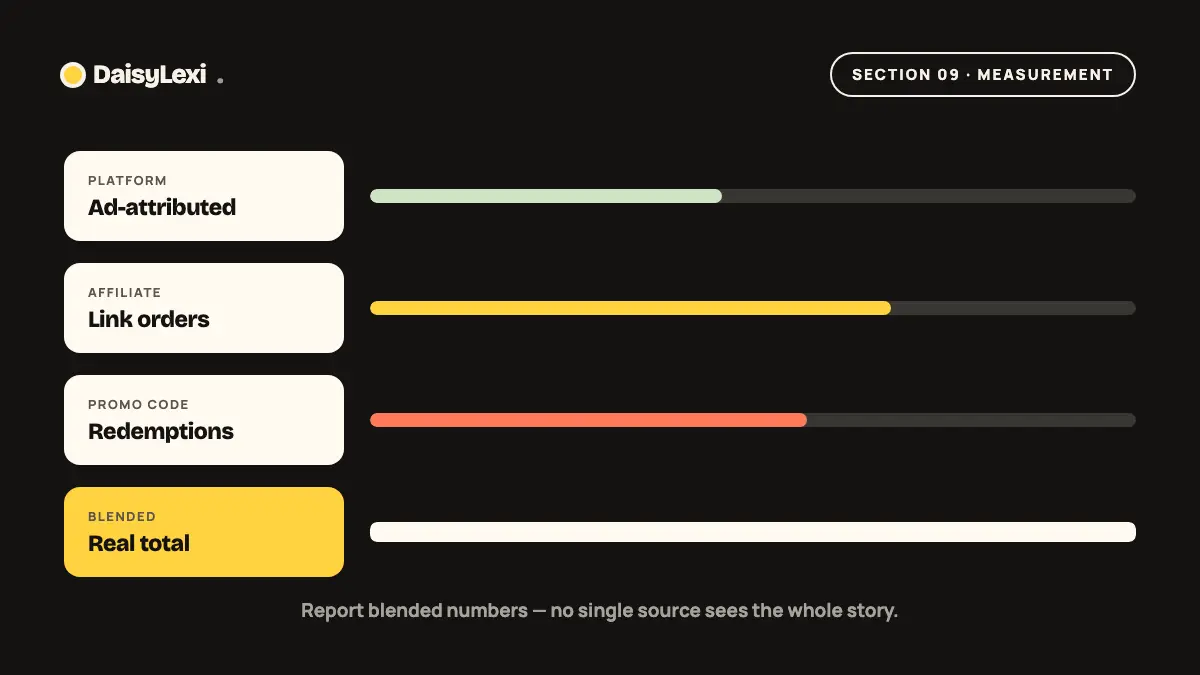
Be honest about attribution limits — and about overlap. Spark Ads report conversions the platform can see; promo codes, affiliate links and post-purchase surveys cover the rest, but the same order can appear in several of those reports at once. Do not add ad-attributed, code-attributed and affiliate-attributed conversions into one blended total: without order-level deduplication you will count some orders twice. Report each channel as a separate attributed metric with its attribution window and source, flag suspected overlap, and if you need a single orders or revenue figure, reconcile unique order IDs in the shop or order system first.
10. Common mistakes that burn budget
Most wasted Spark Ad spend traces back to a short list of repeatable mistakes. The pattern is always the same: the team treats amplification as a media buy separate from the creator work, when it is actually the last step of the same workflow. Fix the workflow and the waste disappears.
- Boosting every creator post equally instead of letting organic performance pick the winners
- Running Spark Ads without a written usage-rights clause — the creator can revoke or the post can be deleted mid-campaign
- Editing the creator's caption or adding a hard-sell CTA button that breaks the native feel you paid for
- Hyper-targeting interests until the ad set cannot exit the learning phase
- Counting only platform-attributed conversions and ignoring promo-code and affiliate redemptions
- Forgetting the paid partnership disclosure label, which is both a policy requirement and a trust signal
11. Vietnam-specific notes for Spark and Partnership Ads
In Vietnam, TikTok Shop is deeply woven into creator workflows, so the strongest Spark Ads setups often combine three levers: the boosted video, the creator's affiliate link in bio or pinned comment, and a campaign-specific voucher code. Each lever covers a different attribution gap — the ad platform sees clicks, the affiliate dashboard sees orders, the code sees redemptions.
Korean and Japanese brands entering Vietnam should note that Partnership Ads on Meta are often the first amplification step because Facebook still carries significant Vietnamese purchase intent in beauty, education and family categories, while TikTok dominates discovery. Running both lets you compare which platform's creator audience actually buys your category.
12. A launch checklist you can reuse
Run this checklist before the first dollar of ad spend. Each item exists because skipping it has cost real campaigns real money — the checklist is short on purpose so it actually gets used.
- Contract or booking records usage rights: posts, platforms, duration, edit rights, takedown terms
- Creator generates the spark code or partnership ad code and shares it before campaign build
- Paid partnership disclosure is enabled on every boosted post
- Landing URL, promo code and UTM parameters are ready and tested
- Test budget set per post, winners identified after five to seven days
- Measurement plan covers platform attribution, affiliate redemptions and code redemptions
- Report includes organic-vs-paid comparison so borrowed reach is visible
FAQ
Frequently asked questions
What is the difference between TikTok Spark Ads and Partnership Ads?
Spark Ads are TikTok's format for boosting an existing organic TikTok post using a spark code from the post owner. Partnership Ads are Meta's equivalent on Facebook and Instagram, using an ad code the creator grants the brand. Both run the creator's own content under their identity with paid reach added.
Do Spark Ads keep the comments and likes on the original post?
Yes. A Spark Ad runs the existing post, so its organic comments, likes, shares and caption stay attached. New engagement from the ad also accumulates on the same post, which is one of the main advantages over uploading a fresh ad creative.
How much do Spark Ads cost in Vietnam?
There is no fixed Spark Ads fee — you pay TikTok's ad auction like any other ad, plus whatever the creator charges for usage rights if it is not already included in the booking. Many Vietnam KOC bookings now include spark code authorization as a standard deliverable, so confirm it in the contract rather than paying twice.
Can I edit a Spark Ad video or caption?
Spark Ads are designed to run the post as published, so heavy edits defeat the purpose. TikTok lets you choose whether to keep the organic caption and whether to add a CTA button; Meta Partnership Ads similarly keep the creator's post intact with a partnership label. If you need full creative control, use the footage in a regular ad instead.
Are Spark Ads better than running UGC-style ads?
They solve different problems. Spark Ads leverage the creator's handle, comments and social proof for trust; UGC-style ads give you full control over edits, captions and landing paths. Strong programs run both and compare cost per result by identity — creator-handle ads versus brand-handle ads.